
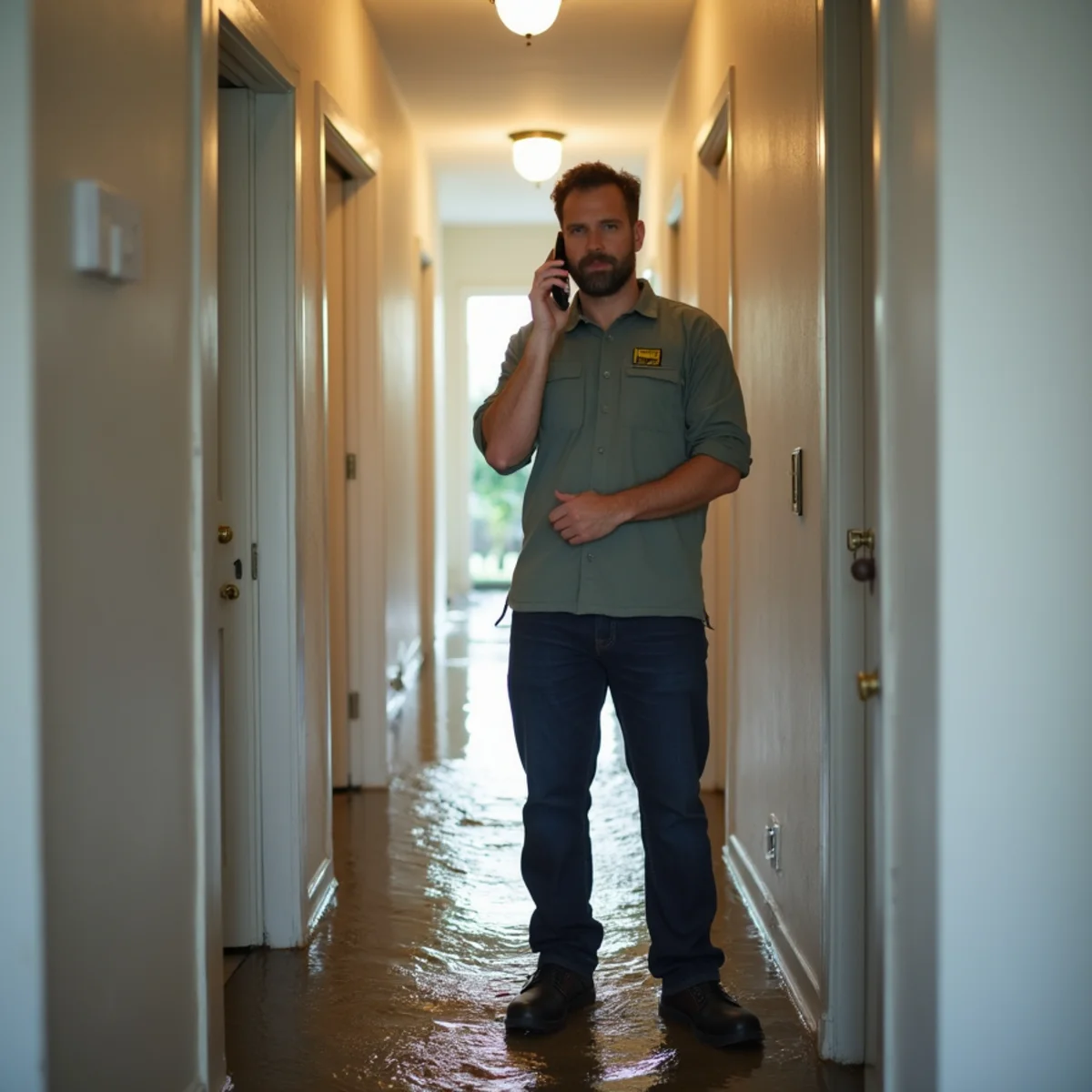
Three phone numbers, one flooded house, and only one right order to call them in. Here's the sequence that actually limits damage and protects your claim.
Your home is flooding and you're standing in the hallway holding your phone, trying to decide who to call first. A plumber? Your insurance agent? A restoration company? The order you choose actually changes how much of your home you end up rebuilding — and most homeowners get it backward.
The Short Answer: Restoration Company First, Then Insurance, Then a Plumber If You Need One
A licensed water damage restoration company can stop the spread, extract standing water, and begin drying within the hour. Most plumbers can't do any of that — their job is fixing the pipe, not saving your floors and drywall. Call restoration first, loop in insurance once mitigation is underway, and bring in a plumber only if the source itself needs a physical repair.
Why not the plumber first?
A plumber can shut down and repair a failed pipe or fitting, which matters. But most plumbers don't extract standing water, run commercial drying equipment, or produce the documentation your insurance adjuster expects. Calling a plumber first — and waiting for their schedule — can burn the golden hour while water keeps spreading through your subfloor and walls. Read our companion guide on burst pipe emergency steps for what to do in that exact scenario.
Step 1: Call a Water Damage Restoration Company
Our line is answered 24/7, and we average a 60-minute arrival anywhere in Lake Forest. Over the phone, we'll ask what's flooding, from where, and how long it's been running — and we can often tell you immediately whether you need a separate trade at all. Many floods come from appliances or fixtures our emergency water damage crews handle directly.
If the source turns out to be a pipe under your slab, we'll flag that early, since a slab leak emergency usually needs a plumber for the repair itself while we manage extraction, drying, and the insurance side.
Mitigation isn't optional — it's the policyholder's duty to prevent further damage from the moment a loss occurs.— Standard homeowners policy mitigation clause
Step 2: Call Your Insurance Company
Notice the order. Most policies actually require you to take reasonable steps to prevent further damage — which is exactly what a restoration crew does the moment they arrive. Starting mitigation first, then notifying your carrier, satisfies that duty rather than working against it.
When you do call, have your policy number and a rough description of the loss ready. We handle direct insurance billing and produce Xactimate-standard estimates through our insurance claims assistance, so you're not translating contractor language for the adjuster yourself. If you're unsure what your policy actually covers, our guide on does homeowners insurance cover water damage in California walks through the details.
Step 3: Call a Plumber — Only If the Source Needs Repair
A surprising number of floods don't need a plumber at all. A washing machine hose failure just needs a new hose. A dishwasher leak often needs a part swap. Others — a slab leak, a burst supply line under pressure — absolutely need a licensed plumber to make the physical repair, separate from the cleanup and drying work.
- Slab leak or underground pipe failure — needs a plumber for the repair
- Burst supply line or failed fitting — needs a plumber
- Washing machine hose failure — usually just needs a replacement hose
- Toilet overflow or drain backup — a plumber may be needed for the fixture itself
- Water heater failure — sometimes a straightforward swap, sometimes we coordinate it for you
What If You're Not Sure Who to Call?
Default to the restoration company. We'll triage the situation over the phone, tell you honestly if you need a separate trade, and get a crew moving toward your address at (201) 277-9344 while we sort out the rest.
What About Nights, Weekends, and Holidays?
Water doesn't wait for business hours, and neither do we. Most independent plumbers charge a steep after-hours premium and may not answer at all past a certain hour, while a dedicated restoration company built around emergencies staffs its line 24/7/365 as a matter of course. That's a meaningful difference at 11 p.m. on a Sunday, when the alternative is watching water spread for twelve hours until someone picks up.
It also matters for commercial and rental properties. A property manager dealing with a flooded unit at 2 a.m. can't wait until Monday to start mitigation — tenants, leases, and liability all move faster than that. The same call order applies: restoration first to stop the loss, then the owner's insurance, then a trade specialist only if the fixture itself needs repair.
How This Plays Out in HOAs and Condos
South Orange County is one of the most HOA-dense markets in the state, and shared-wall leaks raise an extra question: whose insurance pays? Communities like Laguna Woods and Mission Viejo see this constantly — a leak in one unit affects the one below it, and the HOA's master policy, the originating unit's policy, and the affected owner's policy can all come into play. Our HOA water damage team documents origin and damage separately from day one, which is what actually resolves the who-pays argument.
Whatever order the calls happen in, the goal is the same: stop the water, protect the structure, and get the paperwork right the first time. If your home is flooding right now, skip the debate and call us at (201) 277-9344 — we'll help you sort out the rest of the list once our crew is on the way.
Frequently Asked Questions
Will calling a restoration company before insurance hurt my claim?
Do I need a plumber if my washing machine overflowed?
What if my HOA says it's not their responsibility?
Serving your area: We provide 24/7 water damage restoration in Laguna Woods, Mission Viejo and across South Orange County.